Showing posts with label #KYDerby. Show all posts
  • The Triple Crown Ain't Broke

    POSTED Jun 11, 2014
    On Saturday, June 7, 2014 at 6:55 PM Eastern Time, California Chrome stood at the cusp of greatness — 1 ½ miles away from Triple Crown glory. Two and a half minutes later, he was just another in a long line of horses to fail in the Belmont Stakes after triumphing in both the Kentucky Derby and the Preakness.

    2014 Belmont Stakes 


    And, according to California Chrome’s co-owner Steve Coburn, the Belmont result was a travesty.

    “This is his third very big race,” Coburn said of California Chrome immediately after the Test of Champions. “These other horses they always sit ‘em out. They sit ‘em out and try to upset the apple cart.

    “I'm 61 years old and I’ll never see in my lifetime … another Triple Crown winner because the way they do this. It's not fair to these horses that have been in the game since day one. I look at it this way: if you can’t make enough points to get into the Kentucky Derby, you can’t run in the other two races.

    “… It's all or nothing,” Coburn went on. “It's all or nothing. Because this is not fair to these horses that have been running their guts out for these people and for the people that believe in them… this is a coward's way out in my opinion. This is a coward's way out.”

    Coburn has since apologized for his post-race tirade… and for a subsequent tirade on the “Today” show the following morning. Sadly, however, the substance of his comments appear to be drawing quite a bit of consideration from racing fans and non-fans alike — apparently, nothing creates a consensus quite like whining and moaning about the “unfairness” of it all.

    So, I’m writing today to set the record straight: the Triple Crown is not an event, it is an accomplishment.

    Consider: When Sir Barton won the Kentucky Derby, Preakness and Belmont Stakes in 1919, it wasn’t even called the Triple Crown. That term wasn’t widely used — in American racing, at least — until Charles Hatton of the Daily Racing Form popularized it in the 1930s.

    What’s more, when Gallant Fox captured the Crown in 1930, the Preakness preceded the Derby and, for many years, all three races were separated by less than 30 days (versus the five weeks of today). How cowardly were the “fresh” horses in those years?

    The fact is “winning” the American Racing Triple Crown is no different than “winning” the Triple Crown in Major League Baseball (bestowed upon the player with the highest batting average, most home runs and most runs batted in during the season). It is no different than “winning” the Grand Slam of tennis (Australian Open,  French Open, Wimbledon and US Open), which, by the way, has been accomplished exactly three times in men’s singles since 1938 — twice by the same guy (Rod Laver).

    OK, Derek, I hear some of you protesting, but you’re missing the point: horse racing has changed. Thoroughbreds are being bred for speed these days and simply aren’t as durable as in year’s past.

    Alright, then what are the English breeding for, sluggishness? Because there hasn’t been an English Triple Crown (2,000 Guineas, Epsom Derby and St. Leger Stakes) winner since Nijinsky in 1970 — and he was the first  English Triple champ since Bahram in 1935.
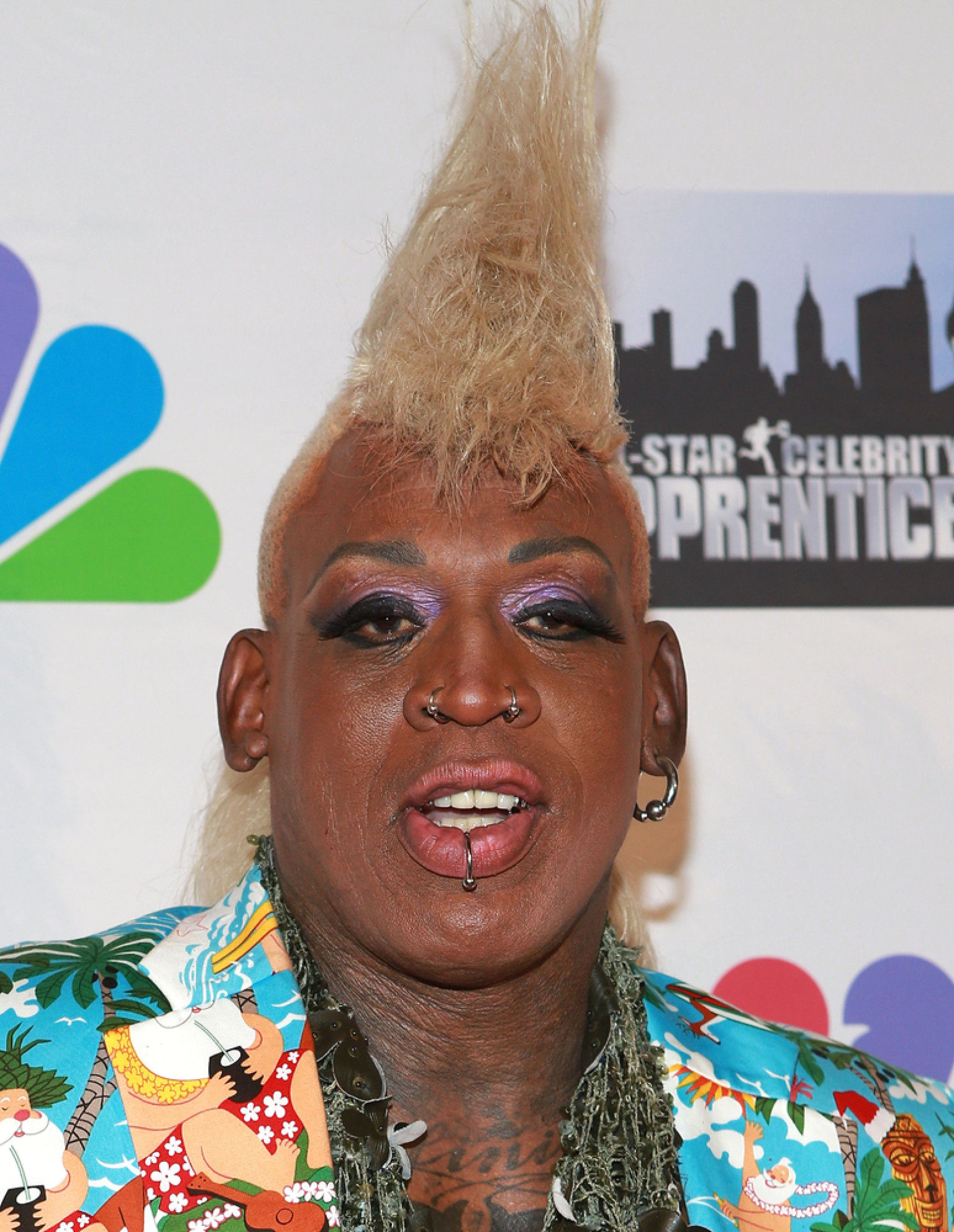
    Dennis Rodman
    Furthermore, all sports change. In a previous column, I noted that of the 50 Major League Baseball pitchers with the most career complete games, only five were born after 1900. Among the NBA rebounding leaders who maintained a career average of more than 13 caroms per game, only Dennis Rodman played post-1983. (As an interesting side note, Rodman also averaged 2.7 different shades of hair and lipstick per game during his career as well.)

    Likewise, among the 30 NFL receivers to average 18+ yards per reception during their careers, only Flipper Anderson played predominantly in the 1990s or later.

    I won’t get into the reasons for this as they’re not germane to this discussion, but trust me when I say we will see the 12th Triple Crown winner before we will witness the 29th .400 hitter in Major League Baseball.

    The Kentucky Derby, Preakness and Belmont Stakes are independent events, all boasting a purse of $1 million or more and all worth winning on their own merit. The list of Preakness and/or Belmont winners that didn’t capture the Triple Crown is legendary: Colin, Man o’ War, Native Dancer, Bold Ruler, Northern Dancer, Damascus, Needles, Nashua, Conquistador Cielo, Spectacular Bid and Sunday Silence… just to name a few.

    Rather than tinker with the Triple Crown format to get more champions, which would represent the ultimate sports asterisk, let’s just salute those great horses that accomplished it… and appreciate those who tried and failed.
  • The Worst ‘Overlay’ in History

    POSTED May 16, 2014
    Ever since California Chrome won the Kentucky Derby in a time rivalled by wooden horses on a merry-go-round, the dissenters have been out in force.

    Racing fans and pundits alike have been quick to label California Chrome as “overrated” or “the best of a bad lot.” Hence, it should come as no surprise that nine rivals have lined up to challenge the Derby champ in the Preakness Stakes, including seven who did not compete in Louisville.

    Now, I’m no chalk-eating weasel and I applaud those who perpetually look for legitimate knocks against short-priced favorites — in any race. But I must admit to rolling my eyes a bit when folks claim that they are “looking for value” by eschewing the Derby winner.

    Value is not determined solely by price.

    One makes a profit at the races by betting on propositions that offer odds over and above their “real,” or actual, odds — period. If a horse has a 90 percent chance of visiting the winner’s circle, a win bet at 2-5 odds is a great wager. Conversely, an exacta that stands to pay $100 for a buck is a horrible bet if the combination is likely to connect fewer times than Donald Sterling at an NBA meet-and-greet.

    The fact of the matter is the Derby runners (and California Chrome in particular) are holding all the aces when it comes to Saturday’s Preakness Stakes.

    In the past 50 years, horses that did not compete in the Run for the Roses are just 7-for-242 (2.9 percent) at Pimlico. Horses that did compete in the most exciting two minutes in sports have won 43 times (16.6 percent) during that span.

    And it gets even worse if the “new shooter” did not win its last race, as only Bee Bee Bee (1972) and Red Bullet (2000) managed to capture the Preakness after failing to get the job done in their previous start. Worse, just nine percent of these horses have even hit the board in Baltimore.


    (Click on image to enlarge)

    Which brings me to Social Inclusion, everybody’s upset special in this year’s Run for the Black-Eyed Susans.

    Simply put, I think Social Inclusion may be the worst “value” play in the history of organized horse racing.

    Look, I get it: next to California Chrome (the Derby notwithstanding), the son of Pioneerof the Nile has the best overall speed figures in the field. But to understand why I think Social Inclusion is such a terrible bet in the Preakness Stakes, we have to dig deeper:

    (Click on image to enlarge)

    This is a horse that has never been headed early and, according to his connections, he’ll be on the engine again in Maryland… yet he’s not very quick. His early speed rations (ESRs) rank fourth in the Preakness field — behind California Chrome, Pablo Del Monte and Ring Weekend. And the only time he met today’s late speed (LSR) par was when he set a dawdling pace (0 ESR) in an allowance win at the notoriously speed-favoring Gulfstream Park.


    2013 WIRE-TO-WIRE RATES (main track)

    Aqueduct (AQU): 26 percent at 1-1/8 miles (23 races).
    Gulfstream Park (GP): 27 percent at 1-1/16 miles (97 races).
    Pimlico (PIM): 20 percent in all routes (100 races).

    Then there’s that stat I shared before: Non-Derby starters who didn’t win their last start are just two-for-144 in the Preakness over the past 50 years. And 5-1 (according to the morning line) is value on Social Inclusion? Value? (Picture Jim Mora asking the question to get the full effect of what I’m saying here.)

    If you’re seeking “new shooters” that have a chance at a good price, look at Dynamic Impact, Bayern or — one I really like — Kid Cruz. And, of course, don’t forget about the other Derby starters: General A Rod and Ride On Curlin.

    History has shown that they’re the ones that typically offer the real value.

    My Plays:

    EXACTA BOX 1,2,3,5,7,10.
    TRIFECTA 3 with 2,7,10 with 1,2,5,7,10.

    To get my Win Factor and Pace Profile Reports for ALL of Saturday's races at Pimlico, click HERE.
  • California Chrome Proves the Race is Not Always to the Swift

    POSTED May 9, 2014

    I’ve said it before, I’ll say it again: racing fans are a fickle bunch. Win in a fast time, à la Game On Dude in the Santa Anita Handicap, and it’s because of a “souped-up” racetrack or a “speed bias.” Win in a slow time, à la California Chrome in the Kentucky Derby, and it’s due to a slow pace and/or a subpar three-year-old crop.

    Look, there’s no denying that California Chrome’s Derby time was on the sluggish side. Since 1950, only Cannonade (1974) recorded a slower winning time on a “fast” track than trainer Art Sherman’s stable star did on the first Saturday in May. 

    And the speed-figure boys concur with the Teletimer.

    Len Ragozin of The Sheets gave Chrome a 7 ¼ — just slightly better than Cannonade’s 8 (lower numbers represent faster times on both The Sheets and Jerry Brown’s Thoro-Graph).

    Brisnet awarded California Chrome a 103 speed figure (well below the 10-year Derby par of 107), while Beyer and his team gave the son of Lucky Pulpit a 97 — the lowest figure for a Derby or Preakness winner since the Beyer figs were first published in the Daily Racing Form in 1992.

    In fact, Beyer was so distressed by Chrome’s lack of speed that he condemned the entire thoroughbred breed.

    “This slow time is not merely an indication the current crop of 3-year-olds is subpar; it can be seen as an indictment of the modern American thoroughbred,” Beyer wrote in the Washington Post immediately after the Derby.

    Now, I’m not a Beyer basher; in truth, I think he has a point (albeit one better made by the Belmont Stakes, in which no winner has cracked the 2:30 mark since 2009). Still, isn’t the angst a bit much?

    After all, I remember reading the same type of stuff about Triple Crown champ Seattle Slew. Only three horses — the aforementioned Cannonade (1974), Canonero II (1971) and Dust Commander (1970) — recorded slower winning times in the Kentucky Derby in the 15 years preceding Slew’s victory in 1977. And Dust Commander competed on an “off” track.

    What’s more, there is no evidence to suggest that a fast Derby time — at least a fast raw Derby time — leads to future success… quite the contrary, actually.

    Of the 20 swiftest fast-track Kentucky Derby winners (based on raw times), only seven found similar success in Baltimore in the Preakness Stakes, producing a $1.64 net return on a $2 investment. In all other fast-track Derbies, the winner went on to capture the Black-eyed Susans 40 percent of the time and return backers a robust 25 cents on the dollar.

    QUICKEST FAST-TRACK DERBY WINNERS IN THE PREAKNESS

    Number: 20
    Winners: 7
    Rate: 35.0%
    Return: $32.70
    $2 Net: $1.64
    ROI: -18.3%

    ALL OTHER “FAST” TRACK DERBY WINNERS IN THE PREAKNESS

    Number: 37
    Winners: 15
    Rate: 40.5%
    Return: $92.80
    $2 Net: $2.51
    ROI: +25.4%

    As for the “slow” pace… well, that’s hooey too. According to my pace figures, several recent editions of the Most Exciting Two Minutes in Sports have featured softer relative opening splits — like the 2008 edition, the 2009 edition and the 2011 edition.

    Furthermore, California Chrome’s -7 early speed ration (ESR) in this year’s Run for the Roses is the third-best since 1996, behind only Smarty Jones (-9 in 2004) and Funny Cide (-7 in 2003).

    Both those horses went on to win the Preakness Stakes.

    Is California Chrome the greatest racehorse to ever look through a bridle? Of course not. But he’s not exactly Zippy Chippy either… regardless of what one’s watch says.