Showing posts with label Ultimate PPs. Show all posts
  • Get to work! Breeders' Cup information overload begins now

    POSTED Oct 8, 2013
    Just one American Grade 1 race--the Queen Elizabeth II Challenge Cup Stakes on Saturday, October 12, at Keeneland--stands between us and the Breeders' Cup World Championships on November 1-2 at Santa Anita Park.

    I.e., now that the horses are done preparing, it's time for horseplayers to get ready for American Thoroughbred racing's second-biggest weekend.

    There will be a lot of information presented to handicappers the next three weeks--including a fair amount by my employer, Brisnet.com--and admittedly you don't need to consume all of it or even most of it to gain an edge when wagering on the Breeders' Cup (or any race, really).

    But one collection of indispensable information for any day at the races is the Brisnet.com Ultimate Past Performances, which is now available for contenders of the Breeders' Cup races. Here's how it works:


    The Breeders' Cup contenders past performances appear under the "track" BREEDERS' CUP (ONLY) with the five Friday races in the "01" file and the nine Saturday races in the "02" file. The track code for these files is BCX.

    Access to each file costs the normal $3, so if you want contender PPs for all 14 races across both days, then it will cost you $6 retail (free if you're a Performance Plan member, $1 if you're a Gold member, etc). Breeders' Cup contenders data files are also available.

    Following your initial download, access to updates of these files--including the final pre-entry file released on Wednesday, October 23--are free. They will be updated daily through October 21. Then on October 23, the final BCX files will be uploaded, and this will be the last Breeders' Cup file until Monday, October 28, when the Santa Anita full-card past performances are available for November 1-2 (including program numbers, morning line, undercard races, etc.).

    Breeders' Cup contender/pre-entry Ultimate PPs will be a part of Brisnet.com's Ultimate Breeders' Cup Handicapping Package, meaning if you buy contender PPs now you'll get a credit on the $25 package available next week. Also included in the package is a preview with handicapping insights and Breeders' Cup statistics, full-card Ultimate Past Performances, analysis on Europe-based runners as well as Spotlight Selections from Mark Johnson, Andy Harrington's National Turf Clocker Report, and Derek Simon's Win Factor Report. All this has a retail value of $60 but will be available for $25.

    TwinSpires.com players receive the package for free when they wager at least $100 on the Breeders' Cup (total across both days)! And another piece of information TwinSpires.com players can use is access to FREE race replays for all American tracks, including marquee Breeders' Cup prep races.

    So enough about how to spend your money with Brisnet.com, let's talk about how all this data over the next few weeks can help you make money!

    As a multi-race wager lover, I try to get a sense of two things when I handicap full cards: 1) who are the most likely winners overall, and 2) where is the Mendoza Line for each race where competitiveness drops off?

    I pretty much do that with any card I'm looking at, but where the Breeders' Cup (and a few other big events like the Kentucky Derby) is different is that I've spent the last 6 months handicapping, watching, and reviewing these horses' races. That's not the case when looking at a Thursday at Keeneland.

    I already have a pretty good idea of how good these horses are. The variables now are how they match up against those who show up, how they're training, and post position. Balancing who to single and when to go deep is an essential part of my Breeders' Cup wagering strategy--a strategy I wish I had back in 2002!

    I'd never want to get married to a horse this far out, but pre-entry time is when a young handicapper's fancy turns to love, and careful study could help avoid that third-date let down of "You smoke?!!" or "You voted for Bush twice?"

    Unlike Derby, there's not a lot of cachet involved with picking Breeders' Cup winners in advance (in part, I'm sure, because you don't get paid extra for such thoughts as you do w/ Derby), so studying now is more about all the possible winners than THE winner. The summary page of the Brisnet.com Ultimate Past Performances is a great cliffs notes for identifying stand outs and a range of competitiveness. Dank, for instance, looks great in the Filly & Mare Turf 

    The Brisnet.com Ultimate Breeders' Cup Handicapping Package will be available on our special reports page beginning Wednesday, October 16, but contender Ultimate PPs are available now.
  • A smoking gun in every race

    POSTED Jul 10, 2013
    As director of marketing for Brisnet.com, one of the parts of my job I most enjoy is getting the Ultimate Past Performances in the hands of more people.

    Partnerships with Hello Race Fans and HorsePlayerNOW have helped spread the word (and the data), but with new blood comes questions, including the most basic of all: "How do I read this stuff?!!"

    The basic race chart and past performance line that comes from it is a lot like a baseball box score in that the information and how it's presented hasn't changed much over more than a century of competition. But just as Sabermetrics and the Elias Sports Bureau changed how we process that information as well as the information we want with it, so, too, has racing evolved with the advent of proprietary data ranging from "simple" speed ratings to complex indices to compare performance.

    The information available is not the only thing to expand, however, as access to that information is easier than ever as well. The aforementioned Ultimate PPs includes dozens of data points that even a generation ago would have required several sources and hours of research to track down. When people ask, "How do I read this stuff" they actually mean, "How do I determine what's important?"

    Like so many questions in racing, the answer is, "It depends." And for me when handicapping what "it" most often "depends" on is PRICE, which is why my favorite line in Len Ragozin's book The Odds Must Be Crazy is "at 30-to-1 I love the line [the horse's form or pattern]; at 3-to-1 I hate it."

    I was reminded of it again (and in a good way) on Sunday, July 7, when Midnight Aria won the Queen's Plate Stakes at Woodbine gate to wire at 16.6-to-1. There was enough not to like about Midnight Aria (distance questions and speed ratings tops on the list) that there's no way I'd have backed this horse as one of the favorites, but the one thing to like (lone speed) made him extremely attractive at the price.


    Now admittedly you don't need Brisnet.com Ultimate PPs to figure out if there's a lone speed type in the race. A bunch of 1s on the left-hand side of the running lines on one horse but not on any others is the best indication, but that still doesn't tell the whole story.

    That's where the features of more designer PPs such as Brisnet.com's Ultimate PPs can come into play. Not only was Midnight Aria an easy-to-identify frontrunner but also his designation as "E8" heightened the gate-to-wire threat. It's not uncommon to find a race with only one "E" or one "8" type, but it is rare that the only "E" is an 8 with the next closest pursuer an E/P 5.

     Again, at 3-to-1 I hate the line, but at 16.6-to-1 I was willing to take a chance.

    Sometimes handicapping a race requires putting all the pieces together like a puzzle to see the big picture, but other times there's such an imbalance between the potential success of a piece of data and the price a horse is offering that that is all you need to know.


  • Belmont Stakes pedigree: looking for that magic cross

    POSTED Jun 6, 2013
    When it comes to pedigree handicapping, I'm not a big fan of saying a certain aspect of a horse's lineage means s/he can't do something on the track. Rather, pedigree helps gives clues as to what a horse might most like to do: run short, long, or somewhere in between and on which surface.

    A horse who figures best going long on the turf can still win sprinting on the dirt under certain circumstances, and vice versa and any other combination you can think of.

    That's not to say pedigree handicapping isn't important, because it absolutely is, not only as an indicator of potential talent but also as one of the few areas that not all handicappers utilize, which leads to better prices.

    Pedigree is most used in maiden and turf races, and for horses stretching out. The one thing those three categories have in common is that they involve horses doing things they've never done before. That's why pedigree handicapping is such a big part of handicapping races like the Kentucky and Epsom Derbys--no horse in those races has typically raced at 1 1/4 and 1 1/2 miles, respectively.

    The Belmont Stakes is similar with its 1 1/2-mile distance, but for whatever reason doesn't get quite the same attention as the Derby from a pedigree perspective, and that's a shame because some trends have clearly developed over the past 22 years since Hansel, by Woodman out of a Dancing Count mare, won the 1991 Belmont Stakes.

    That marked the first time a Mr. Prospector-line stallion out of a Northern Dancer-line mare would win the Test of the Champion but certainly not the last, as it has happened an astonishing seven times since with Mr. Prospector-line stallions accounting for another five wins on top of that and Northern Dancer-line broodmares another three wins. The reverse cross of a Northern Dancer-line sire over a Mr. Prospector-line mare accounted for last year's winner.

    The following chart below shows the sire and broodmare sire lines of all Belmont Stakes winners going back to Summing in 1981. Mr. Prospector is present in 16 of the past 31 winners with 15 of those coming on the sire side. Northern Dancer is in 16 of the past 27 but more evenly distributed on top five times and with the dam 11 times.

    So who has the magic combo in this year's group (Belmont 2013 tab)? Palace Malice and Will Take Charge are both by Mr. Prospector-line stallions out of Northern Dancer-line mares while Golden Soul and Midnight Taboo have the reverse of that cross that last year's winner Union Rags has. The only other Mr. Prospector-line stallion in the race is the filly Unlimited Budget, whose dam is from the In Reality line. That's the same cross 2000 winner Commendable had.

    A.P. Indy is a popular sire line this year, but the only success he's had in the race since winning it in 1992 was with Rags To Riches in 2007. Still, all three of his representatives are out of either Northern Dancer- or Mr. Prospector-line mares.

    Is all this to say that you need Mr. Prospector and Northern Dancer influences to win the Belmont Stakes? Of course not. There are plenty of pedigrees we could look at with both those heavy hitters in the sire and dam lines and think this horse has no business on dirt and/or around two turns, but the great thing about the American classic races is that despite their distances they all require brilliance. Plodders and deep closers rarely do well in any of the three races. Classic breeding begets classic success.

    Full disclosure: I happen to be director of marketing for Brisnet.com, which specializes in providing a lot of this info to handicappers. Brisnet.com Ultimate Past Performances include pedigree information not found in any other product, and tbe Brisnet.com American Produce Records (APR Online) allows users to search by entry and is great for handicapping maidens, turf races, and stretch outs.
  • Spiral Balancing act: what if Mac isn't The Man?

    POSTED Mar 22, 2013
    A popular tenet of wagering on horses is to "bet with your head, not your heart" (also: "bet with your head, not over it").

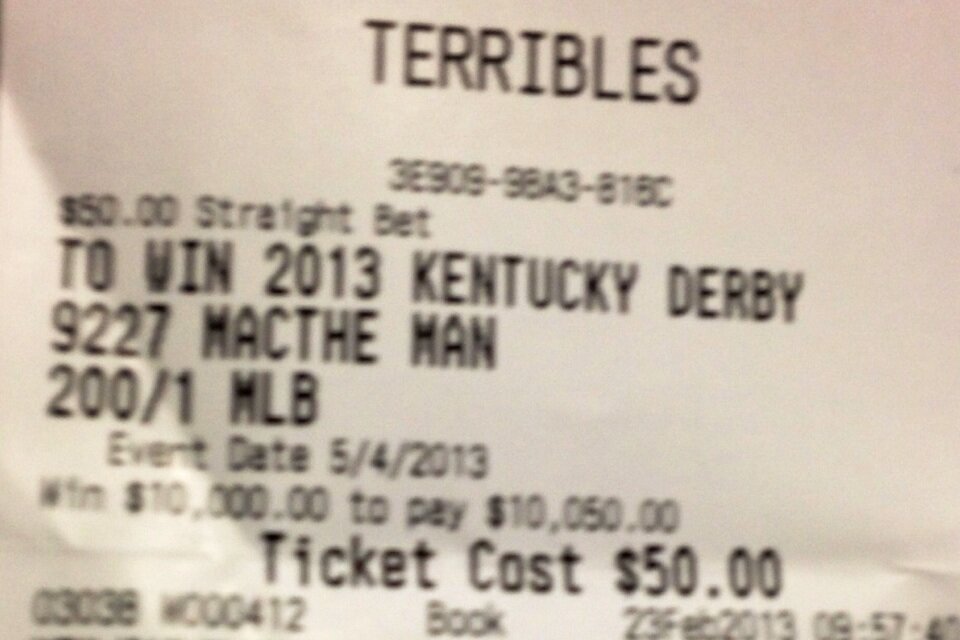
    I'm trying to keep that in mind (and take it to heart) when it comes to plotting my wagering course  for Spiral Stakes day on Saturday at Turfway Park, but it's hard for me not to get excited about Mac The Man being in the gate for the Horseshoe Casino Cincinnati Spiral Stakes (click for free Brisnet.com Ultimate PPs w/ comments for both Kentucky Derby Championship races this weekend).

    I've had Mac The Man ranked second on my Kentucky Derby poll since the El Corredor colt won the 96Rocks Stakes on February 2 at Turfway Park. He wasn't there then--and he's not there now--because I think he is the second-most likely winner of the Kentucky Derby Presented by Yum! Brands. Rather, I just thought he'd be overlooked given his location (Turfway) and connections (trainer Jeff Greenhill).

    I.e., 200-to-1 certainly seemed like the right price to take on one of only a few multiple stakes winners among this crop who had run fast enough to date to indicate that a Derby win wouldn't be out of the question with improvement. Admittedly, I'm more concerned with his pedigree than his speed, but if he's in the Derby gate I won't need to worry about it that much with this price locked in.

    OK, you get it; I like Mac The Man. So how do you bet the race? I don't think we'll get the 10-to-1 morning line, but betwixt Uncaptured, Balance The Books, and Capo Bastone I can't imagine we'll have to take anything less than 5-to-1 on Mac The Man.

    Uncaptured is the morning line favorite, and while I do think he will be the wagering choice, he doesn't seem to be the pick of many handicappers. Marty McGee of Daily Racing Form fame is against him in the top spot as is Joel Cunningham of Triple Crown Insider.


    I wouldn't like Balance The Books at Mac The Man's morning line price let alone as the second choice against this group. I like Uncaptured more, but I'm willing to play against him as the favorite.

    All this means that while Mac The Man is "the top pick", I certainly don't want to be ripping up tickets if Jill Byrne's picks--My Name Is Michael (10-to-1) & General Election (12-to-1)--come in because I think they're capable enough at nice prices.


    Turfway Park has a great multi-race wagering menu with $.50 minimums on all Pick Ns--rolling Pick 3s, Pick 4s that start in races 1, 5, & 7, and a Pick 5 in races 7-11. The all-graded stakes Pick 3 (races 8-10) anchors the Pick 4 and is the meat in the Pick 5 sandwich. It's conceivable that not a single favorite wins, though Pure Fun in the Fathead Bourbonette Stakes looks to be the most likely winner on the back half of the card.

    I won't be able to resist keying Mac The Man in Pick Ns and playing him across the board at a nice price, but I'm willing to give up some value on him to bet against the favorites as well.

    Here's a look at my ABC selections for the whole card:

     
  • Three preps and a cloud of dust

    POSTED Jan 31, 2013
    With 51 points available this weekend (17 in each of three Kentucky Derby Prep Season races), the February 2 action will be the most lucrative to date on this year's Triple Crown trail.

    For free Brisnet.com Ultimate Past Performances for the three races (Sam F. Davis at Tampa Bay Downs, Withers at Aqueduct, and Robert Lewis at Santa Anita), click here. No race this weekend features a horse currently among the top 11 points earners through last weekend, but that would change even for a horse without any points with a win.

    Triple Crown Insider returns for this big weekend on the Derby trail. Watch the video below to see who JS & JC like in this weekend's big races.


    Be sure to check out HelloRaceFans.org for updated information on the Road to the Kentucky Derby (and Oaks!), including schedules, standings, etc. And sign up for its Derby Prep Alert e-mail for info on the big races including free Brisnet.com Ultimate Past Performances (PPs) for each race!
  • The Jazzman: from babysitter to Pick 6 hitter

    POSTED Jan 24, 2013


    Six years ago when “a crazy girlfriend” he had met at church dragged The Jazzman to Palm Beach Kennel Club to babysit her kid so she could bet the races, the South Florida musician never imagined he’d be playing the races from home let alone winning $270,448 on a $10 wager in the process.

    But that’s exactly where the blues player from West Palm Beach found himself on Monday when he turned a $10 Pick 6 play on TwinSpires.com into $270,448, and he’s taking requests on what to do with the money.

    “I have some bills to pay off, and I’ll probably put the rest into a money market account,” The Jazzman said. “I need to do something exciting, though. Got any ideas? I’ll probably take some swings at Gulfstream’s [$500,000-plus Rainbow^6] carryover.”

    The Jazzman is no stranger to small bets with big rewards. In 2009 he hit a $53,000 Pick 6 at Fairplex on a $4 ticket. For his more-than-quarter-million-dollar score on Monday, he played three tickets: a $2 ticket using all favorites, a $4 ticket using no favorites, and a $4 ticket combining his most likely winners with the longshots he liked most such as Renee’s Titan in the Santa Ynez.

    It was that last $4 ticket that hit for $270,448 as one of two winners of the bet on the day.

    “I got up Monday planning to play the Pick 6,” The Jazzman said. “The first thing I do is download the Brisnet past performances on TwinSpires since I get those for free when I bet and look at pace, speed, and class. Then I look at the jockeys of contenders. The thing I follow most is Southern California jockeys; I follow those jockeys like a groupie follows rock stars.”

    The Jazzman credits knowing all the jockeys in the colony—not just the stars like Mike Smith and Rafael Bejarano—with leading to his Fairplex score, and his faith in Tyler Baze served him well when that journeyman piloted Renee’s Titan to win the Santa Ynez over heavily favored two-year-old filly champion Beholder in her three-year-old debut.

    The Jazzman’s strongest opinion was in the last race with $6.20 winner Judge Carr. Live to only that horse for a monumental score instead of hedging with others in the race, he simply bet Judge Carr to place to add another $3.40 to his $270,448 score.

    Despite the big score and zest for chasing other carryovers, The Jazzman doesn’t plan to change his approach.

    “I learned to handicap using the Brisnet PPs,” he said. “There’s so much information there I remember the first time I opened it up and said, ‘My God.’

    “But I stuck with it and stuck with my approach of always making a concerted effort to bet a small amount of money. I don’t like to overwhelm myself with a bunch of horses in every leg. These guys sit around at the track and they have ten horses in a leg and still lose.

    “You can do a lot with $200, but you can do a lot with $10 too. The most important thing is you have to study."


  • It's Opening/closing day/race at Lincoln

    POSTED Jan 8, 2013
    Punters playing the first race today at Lincoln Race Course (FREE Brisnet.com Ultimate PPs) will look to get their meeting started and ended on the right and left feet, as the $3,500 claiming event for Nebraska breds is the only race at the Lincoln, Nebraska, track.

    The one-furlong contest with a $3,900 purse satisfies Nebraska law that requires tracks to conduct at least one live race a year to offer simulcasting.

    Omaha Exposition and Racing is conducting the race and is offering win wagering only on the three-horse field with The Straw Man the 7-to-5 morning line favorite. The 11-year-old Canaveral gelding is unraced since April at Fonner but has two workouts this year at the track for owner-trainer Brian Roberts.

    The Straw Man's nine-month layoff is the longest of the three entrants, but they've all been on the shelf since at least August 26. Still, the biggest question is probably the one-furlong distance of the race rather than the layoff since they've all posted a workout at Fonner this year.

    Because of the distance, my choice is Sonic Bloom, the only "E" type in the race, and as the longest shot at 3-to-1, why not? The Straw Man is an "S" type who has run distance races, so I can't imagine a furlong is his optimal distance. Bluff Center Road is at least an "E/P" type, but the worst race on his page came at four furlongs, and while his E1 pace figures are faster than The Straw Man's, they're typically slower than Sonic Bloom.

    A good jockey is essential for gate speed, and though The Straw Man has the biggest "name" in 19% rider Jake Olesiak, Sonic Bloom's rider, Jose Ranilla, is a solid 12% overall with a 15% strike rate on "E" types. Bluff Center Road's jockey, meanwhile, is a lowly 3% overall and an even worse 2% in sprints, which tells me any edge he might have would come in longer races.

    Unfortunately, TwinSpires.com is not carrying this prestigious event from Lincoln, but I know a guy who knows some guys in Nebraska, so I'm hoping I can still "get down" on a top pick who also happens to be the longest shot on the morning line.

    UPDATE: Sonic Bloom won and paid $3.20. See how easy it is to handicap with Brisnet.com Ultimate PPs?
  • Portland Meadows carryover/0% takeout Wednesday

    POSTED Oct 3, 2012
    TwinSpires.com players already had a reason to play Portland Meadows' early Pick 4 every Wednesday, but the pot is even sweeter today (October 3) because of a $3,558 carryover after no one picked four on Sunday's card.

    Those who follow me on Twitter or catch my weekly segment on "At The Races" w/ Steve Byk (brought to you by TwinSpires.com, where players win) know that I'm not one to shy away from tracks off the beaten path. Sure, I love the social aspect of playing along with everyone else at the usual outposts like NYRA, Kentucky, and Southern California racing, but if there is free money in the pot at Assiniboia, Northlands, or Portland Meadows then I'm going to go for that too.

    One of the reasons I love Brisnet.com Ultimate Past Performances besides they keep me employed is they give the user a quick snapshot of how a particular meeting is playing. I don't follow Portland Meadows on a daily basis, but the detailed jockey-trainer statistics along with the Ultimate Race Summary page give any user a leg up on how the track is playing.

    All four races in today's sequence are sprints, though of varying distances from 4 1/2 to 6 furlongs. A quick glance through the PPs reveals that speed holds extremely well around one turn and that starting position is fair.

    The Ultimate PPs are also good for handicapping for an off track--something that seems to come into play more at Portland Meadows than other venues--but the forecast looks clear for today.

    The basic plan of attack will be that I need two "A"s to win, and I'll probably treat the Bs the same as Cs for that purpose. I could play every pick on this sheet for $400, but I'd rather give myself a chance to hit it multiple times, as I do see the "A" tabs as formidable here.

    UPDATE (3:30 p.m. EDT):
    The scratch of #4 Sicily Grace in race 3 has me rethinking my strategy since she was a lone "A" (i.e. a single) in that race. I've decided that rather than elevate #s 1, 2, & 7 to "A" status I'd still treat them as "B" picks and build my tickets around the remaining "A" selections.

    I've put together seven tickets with my lone "A" picks in races 1 and 4 singled on five tickets each and the cold 1-1 double sandwiching the sequence appearing on three different tickets. I like the remaining "A" picks enough that I'd rather hit the ticket many multiple times if they come in rather than spread elsewhere.

    UPDATE (the morning after):
    Well, B-A-A-X doesn't pay. I didn't like the last leg winner at all. She was dropping down to the level at which she had broke her maiden (against males, no less) and retained her jockey--the 27%-at-the-meet--Anne Sanguinetti, but others just seemed faster in here, and she was highweight.

    The real "miss" for me was not elevating first leg winner Singing Yankee to an "A" when it was obvious that the public was backing her with both fists for her debut. The toteboard said only Jenny's Turn or Singing Yankee could win the race, so putting most of my eggs in the former's basket while playing the latter in equal weight with some bombs wasn't a great strategy.

    The Pick 4 "only" paid $252 for a buck, so I didn't miss a home run, but a 2x3x3xA was only $126, and an even money return would have been fair value in that case.
  • Form form and the greatest race ever

    POSTED Jun 22, 2012
    I don't know if playing the races was ever not a numbers game, but social media has certainly heightened the general public's awareness of how a number can indicate performance.

    Within hours of Frankel's scintillating win in the Queen Anne, Timeform released a provisional rating of 147, which is the highest it has ever assigned. Some point to the figure as proof that Frankel is "The Best Ever," but Timeform has no rating for Secretariat's Belmont or Spectacular Bid's world record in the Strub--both of which I have to think would have at least cracked the 140 barrier that no North American race has produced.

    Speaking of the North American Timeform ratings, I tend to think they're deflated. Exhibit "A" is Cigar rated best of all North American horses listed. I don't know which race Cigar earned his 138 in, but I'd be willing to take either Ghostzapper's Woodward or his Breeders' Cup Classic over it, and his Timeform ceiling was 137.  Exhibit "B" is that Ragozin and ThoroGraph figures for foreign horses are routinely slower for European races than our races here. TG's Jerry Brown would attribute this in part to North American medication policies, including the use of Lasix, but overall I do think North America has faster horses than Timeform gives it credit for.

    It's tough if not unfair to compare Spectacular Bid to Frankel with any absoluteness. I'd take Frankel in the Breeders' Cup Mile and Spectacular Bid in the Breeders' Cup Classic. Maybe the San Diego Handicap at 1 1/8 miles on Polytrack is the best test of these two? One thing Spectacular Bid and Frankel do have in common, though, that I really admire from an "all-time great" standpoint is that each was a top-class performer as a two-, three-, and four-year-old.

    Of course there are many ways to rate racehorses and races: speed ratings, performance figures, pace-adjusted speed figures, pace, class, etc. An under appreciated metric is the Brisnet.com Class Rating, which can be found in the Ultimate Past Performances and is a riff on the "who beat who and by how much" system that made Performance Rates popular.

    On a micro level, the Brisnet.com Class Rating is a powerful handicapping tool. I trust it to compartmentalize the class in each race and separate contenders from non contenders. The numbers fit in a tight group (90 for bottom level claimers through 125 for top stakes performers), so small differences mean a lot. E.g., a horse capable of a 120 Class Rating is far superior to one who tops out at 117.

    On a macro level, the Brisnet.com Class Rating can help distinguish between all-time greats. 125 is a superlative figure, and only one horse in the history of the rating has cracked 130: Workforce when winning the 2010 Prix de l'Arc de Triomphe.


    Frankel's best number is127, which he earned in the Sussex Stakes when defeating multiple Group 1 winner Canford Cliffs by five lengths. Sea The Stars also topped off at 127 for his Coral Eclipse Stakes victory, and he had three other efforts of 125+.


    Ghostzapper is the only horse to appear in the top 19 twice, which he achieved in the aforementioned Woodward (over eventual Horse of the Year Saint Liam) and Breeders' Cup Classic (over Horse of the Year Azeri, defending Classic winner Pleasantly Perfect, eventual Dubai World Cup winner Roses In May, Belmont-Travers winner Birdstone, and multiple Grade 1 winner Funny Cide in stakes record time).Cigar's best was a 126, which he earned in the 1995 Jockey Club Gold Cup, but his five ratings of 125+ is certainly impressive.

    And what of those fabulous females in recent years? Zenyatta notched a 126 in both her Breeders' Cup Classic efforts plus a 125 in her Ladies' Classic. Rachel Alexandra hit the 127 mark twice: the Mother Goose and the Haskell as well as 126 in the Kentucky Oaks and 125 in the Fleur de Lis. Havre de Grace peaked at 125 in both the Woodward and Beldame. Blind Luck never topped 123, but she maintained that pleateau seven times. Royal Delta's recent win earned a 125, which is a career best for the champion.

    I typically use Class Ratings to assess individual performance, but given the historic perspective of this post, it's impossible to ignore the corker that was the 2003 Breeders' Cup Turf, which featured a dead heat between defending winner High Chaparral and Johar with multiple Group 1 winner Falbrav in third.

    Just as "Greatest Racehorse Ever" can mean different things to different people, "Greatest Race Ever" can too, but there's no doubt that this is the best race I've ever seen live, and I certainly would lobby on its behalf for inclusion on a short list of greatest races ever.


  • Anatomy of a 70-to-1 winner

    POSTED Apr 23, 2012
    Publicly picking (or at least tweeting) a 70-to-1 winner of a graded stakes race is a lot like performing a magic trick--some are impressed and others want to know how you did it.

    Unlike a magic trick, however, picking such a winner is difficult to repeat. 70-to-1 shots do not win that often (1.4% if the odds are actually correct), and even when it happens again, it's not like I'll necessarily be on it. If I'm 70-to-1 to pick a 70-to-1 horse who wins then the odds are actually 5,040-to-1 of it happening, but that's still a better chance than I have of making the Statue of Liberty disappear.

    And besides, the important thing is I had this one: All Squared Away to win the Lexington Stakes. And the lesson here for those asking how I landed on this one is not dissimilar from what I took away from Dullahan beating me in the Toyota Blue Grass Stakes: The most important element of handicapping a horse race is asking not "Who will win?" but "Who can win?"

    It's a topic I've addressed a few times on Hello Race Fans:
    One of the biggest mistakes people make when handicapping races is asking the question, “Who will win” rather than “Who can win,” and it is the rationalist that [Andy] Beyer speaks of who will look at the numbers and be able to determine who is too slow to contend.
    Three things jumped out at me when reviewing All Squared Away's Ultimate Past Performances on Saturday morning:

    1. His previous two BRIS Speed Ratings were in the low 90s and that was good enough to contend with this group with any kind of improvement for...

    2. first-time trainer Wesley Ward (a 29% win/58% in the money angle according to the aforementioned PPs.

    3. Those two low 90s BRIS Speed Ratings were both earned closing into a slow pace, which I did not think would be in play in the Lexington.

    There were some negatives, too, of course: The outside post was a concern given posts 8 and beyond had won just 4% of the races going 1 1/16 miles at Keeneland, and finishing sixth and seventh beaten a combined 19 1/2 lengths in two graded stakes tries didn't inspire, but again, how much inspiration do you need at 50-to-1? The three positives above told me the horse could win, and at that price I had to take a shot.

    In the end, 10% of the money I bet on the Lexington Stakes was on All Squared Away, so it's not as if he were my top pick in the race, but successful betting requires the handicapper not to get enamored with who will win.

    It's a great lesson to bring with you to the track--especially on Kentucky Derby day when so much importance is placed on WHO WILL WIN THE KENTUCKY DERBY. It's a satisfying question to get right, and I'd love to see I'll Have Another win for that reason but not at the expense of a horse I've bet at 40-to-1 because he can win.

  • Sweet fantasy

    POSTED Feb 24, 2012
    Most would say that racing has failed to capitalize on the fantasy craze as well as other major sporting events, but that would be to ignore the idea that horse racing is the original fantasy game since cheering on Tom Brady for fantasy points is similar to cheering home a winner to cash a ticket.

    Other sports also have a clearly defined season with (mostly) balanced schedules that makes calibrating the worth of players against each other and the rules of the game a lot easier than in racing where number of starts and type of race (e.g. Grade 1, Grade 2, etc.) are variable for each horse from start to start.

    Still, if American Thoroughbred racing has any season, it's the Triple Crown and the road to the Kentucky Derby. In this way, playing a fantasy game related to those pursuits is a hybrid of March Madness bracketology and fantasy sports. The end goal is unquestionably to win the Kentucky Derby and other classic races, but there are different ways to get there, and those different paths are each worth a different amount of points.

    How to make sense of all those horses? Luckily there's help. The first place to start is with FREE Ultimate Past Performances for all Triple Crown nominees. The file is updated each week. For those looking for more in-depth of analysis of (likely) classic contenders, the Triple Crown Preview from Blood Horse is the type of product fantasy players are used to seeing from sports periodicals priming players for the upcoming season. It includes analysis of 40 Derby aspirants along with historical data and commentary.

    Once you have your teams set, you'll want to keep track of when your team competes. Brisnet.com Stable Alert allows you not only to track horses but also trainers. Load up your stable and enjoy! For a great summary of the weekend action, subscribe to Hello Race Fans Derby Prep Alert, which includes previews of the weekend's big stakes action along with free Brisnet.com Ultimate Past Performances.

    As with any fantasy game, it's important to know how to score points. In contests that put a premium on winning the Derby, I find it's more useful to take a horse you think has any chance of being in the gate for the big race than what might appear to be low hanging fruit with a sprinter type like Thunder Moccasin who could score some points in a race like the Swale but won't get you anything in May-June.

    For the Road to the Roses contest, which begins scoring with the Risen Star Stakes, there's a slight premium placed on the Kentucky Derby, but as a percentage of overall points isn't a huge pull.

    My strategy with a league of Road to the Roses' magnitude--in which many will play and all horses/trainers/jockeys are available to everyone--is you have to find that balance between not missing out on obvious points while still zigzagging in the right direction. For instance, I took Baffert because of sheer number power and how effective he is at managing those numbers to win races coast to coast. It's not particularly clever--everyone will have him--but that's just not the spot where I wanted to take a stand.

    The the chance to enter three stables, Road to the Roses allows a bit of juggling. I took Mike Harrington as my trainer in one of the stables and Matz in another. Harrington has two strong bullets while Matz has the overall fastest horse (assuming Union Rags hasn't lost anything from 2-3).

    Either way, my core horses who appear in all three stables--Creative Cause, El Padrino, Empire Way, I'll Have Another, Out of Bounds, and Union Rags--will have to do well for me to do well.

    Good luck to all playing!


  • FREE Ultimate Past Performances

    POSTED Feb 23, 2012
    In case you haven't heard, Ultimate Past Performances is FREE through February 29 (the promotion applies to the date the track is running, not when you buy).

    Of course, this type of promotion is just every day living for TwinSpires.com players, who receive free Brisnet.com past performances for the tracks on which they wager.

    I have been using Brisnet.com Ultimate Past Performances since January 1998 when a similar free promotion got me to sign up. As someone used to using the Equibase-style program on track, there was a bit of culture-shock-information-overload the first few times I interacted with the Ultimate PPs, which feature speed ratings, pace figures, race and class ratings, Prime Power, pedigree information, and detailed jockey and trainer statistics--all elements other past performance products have added through the years because of the popularity of Brisnet.com's products.

    For a quick tutorial on using Brisnet.com Ultimate Past Performances, click here. The most important thing to remember is that just because all that information is available does not necessarily mean you need to interact with all that information each race.

    When looking at a six-furlong race for bottom-level lifetime claimers on the New York circuit, for instance, the pedigree information is unlikely to be very helpful. Similarly, when evaluating a second-time starter who had trouble throughout his entire debut trip, you're better off using trainer-jockey stats and pedigree info than you are figures related to that horse's troubled performance.

    The key is that all that information is available each race, and the more you interact with it the more adept you will become at handicapping efficiently.

    NHC Tour winner Paul Shurman has a great approach when using Brisnet.com Ultimate Past Performances to complement the other information he uses.

    "I do use a lot of different products, especially for tournaments," said Shurman, who also finished sixth in the National Handicapping Championship. "What I rely on most from Ultimate Past Performances are the track bias stats and the pedigree stats, especially the dam production index when applicable. I have a template made up for tournaments; it's sort of like a checklist for every race, so I have all the information from all my different sources right in front of me, and I don't forget to consider something.

    "The first thing I do when I start handicapping is to make notes for every race in the contest on track bias from the Ultimate Performances. Then I go through pedigree information and mark down anything of significance."

    On balance, my favorite "exclusive" of the Ultimate Past Performances is the class rating, which measures a horse's performance against every other horse's performance not only in that race but also how those horses have performed in future races. I'm a speed figure devotee, but I have found that while speed figures are the best predictor of current form, the class ratings deliver an explosive assessment of relative talent. Entries with a class rating even two points lower than the median for a race are typical underlays, and 3+ points renders them a complete nonfactor.

    Enjoy the promotion!
  • Hot to Trotter

    POSTED Jan 25, 2012
    Congratulations to A.C., J.F., and J.M. for being the inaugural inductees into the Jay Trotter Hall of Fame!

    Unfortunately Jennifer Tilly wasn't waiting at the end of the Let 8 Ride rainbow, but in addition to their enshrinement into sacred space, the trailblazing trio turned $8 into $911.20, a 37.8% premium from the $661.20 the Trots earned on their win betting. The $250 extra came from them being one of four players to select winners on Wednesday, Thursday, and Friday. The fourth person not inducted (C.K.) lost his $8 win bet on Saturday but still collected $250, which is pretty great considering he started with an $8 win bet and lost a parlay wager.

    LSS--that's long story short--you can win even when you lose with Let 8 Ride... provided you've already won on Wednesday and Thursday, of course.

    Speaking of winning on Wednesday, a new game starts with race 8 tonight (and every Wednesday) at Delta Downs! Check the link for free Ultimate PPs w/ comments from Brisnet.com.

    Tonight's race is all about speed. It's an entry-level allowance race for older females, and each of the eight entrants have either an "E" or "E/P" pace designation. That's just an indication of running style, though, based on the pars for the race only a few of these are likely to actually make the lead.

    My top pick is #3 Phone Marybe, whose bad races came when marooned on the outside but is inside for this. I like that he's rated and won, which should do the trick against this bunch.

    I've advocated dutching in the first round of this game because the value comes from making it to Friday when losers split $500 and winners player for an added $1,000 on Saturday. I like Phone Marybe so much in this race, I'm not willing to give up value by betting others. I'll add the caveat that since #s 4 & 7 look to be underlays based on their morning line, I might take a flyer on #s 1, 2, or 5 if any are big bombs, but with only 8 horses signed on and lots of speed, I expect a compact odds board and thus the trey is the play.
  • Figure 8 is really great

    POSTED Jan 18, 2012
    If "Is it Wednesday yet" isn't the mantra of Delta Downs players everywhere then--barring a lawsuit from ESPN--it should be because nothing can beat the excitement of turning an $8 win bet into more money and bragging rights through the Let 8 Ride promotion.

    Well, OK, many things can, and if you're doing one of those things--e.g. riding a roller coaster, bowling a 300 game, or eating at an In N Out Burger without WiFi access--then you're excused from playing in tonight's contest, but otherwise download those race 8 Ultimates for tonight at Delta Downs and find the winner!

    Through two weeks there has yet to be a player who has successfully let it ride on four consecutive days, which entitles the winner to not only cash but also enshrinement in the Jay Trotter Hall of Fame. I made it through day one last week with a $22 winner but needed two win bets to get there. That luxury isn't available on day two, and I got suckered into a bad favorite. The second choice won and paid a healthy $7, but I was down to squadouche.

    I might go four deep tonight depending on odds. I expect two of my choices to be absolute bombs and the others are logical favorites. If one of the logical horses wins at 2-to-1 then I'll actually lose $8 because I've risked $32 on a $24 return. However, the game is to Let It Ride, so a winning bet on Thursday should put me in the black. This would not be my plan normally if not for the provision that those who surivive into Friday play for a $500 prize pool with $1,000 on the line for those who make it to Saturday. I'm not actually eligible for the added value, but I like to play along to the letter of the rules so that I can offer the best advice possible. Plus all that churn gets me closer to bronze status.

    My top pick in here is #6 Smart Trick, one of only three "E" speed ratings in the ten-horse field, but who, with six Quirin Speed Points, is easily the fastest of that trio. Those with an "E" Speed Rating win one-mile races at Delta at a 35% clip, so he's poised to be in the right spot. I'm not thrilled with an 0/10 trainer in 2011-2012, but the apprentice allowance should help, and this horse has been fast enough to win at this level. There's lots of other stuff to like, too: It's his third-start off the layoff, and he had a decent work between today and his last start. He also moves inside from post ten last week after racing near the lead three wide.

    Speaking of workouts leading up to a third start off a layoff, #3 Lone Renegade also fits that bill, and he also moves inside from making his last start from post ten. His last two starts off the layoff were on a muddy track, and he's 1/12 on off tracks but 7/52 on fast tracks. This one wouldn't be impossible.

    The two favorites, #4 Hitnotiq and #7 Dowhatnow, make perfect sense and wouldn't shock me, but they will be overbet. In the spirit of this game, and I want to use them in the hopes of continuing, but either could have too much work to do late and if both do then this thing pays boxcars.

    For those who need some assistance figuring out what $8 to win pays, here's a little help from Schoolhouse Rock.